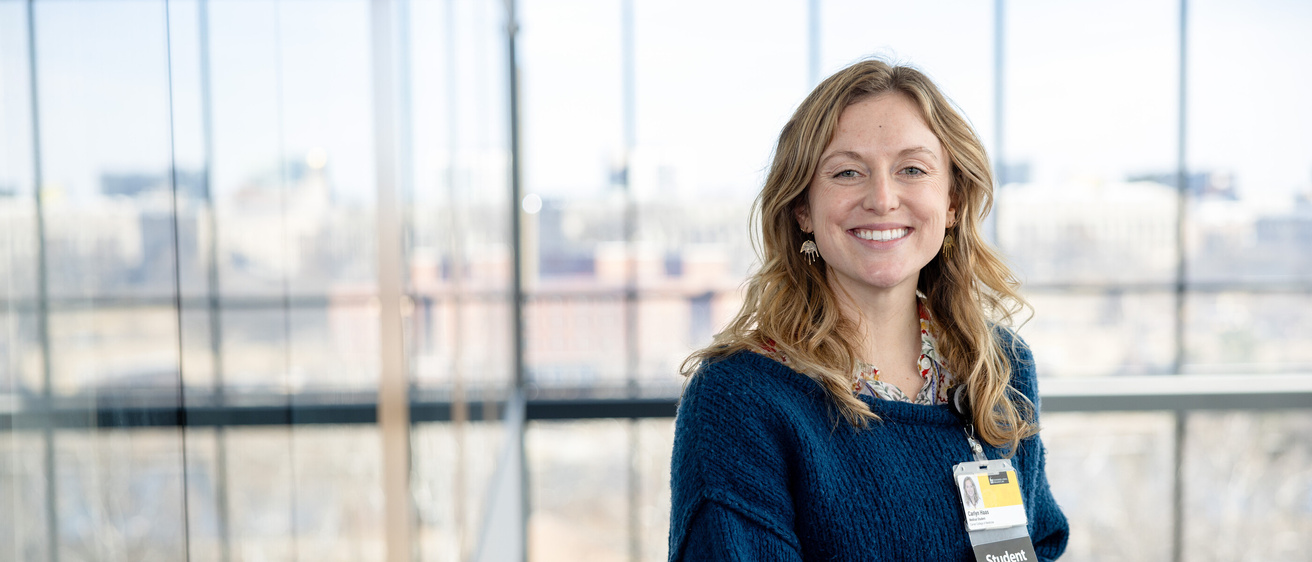
Looking back, Carlyn Haas can see how the varied roots of her passions and interests grew into the career she chose. But she wasn’t one of those 5-year-olds who always said, “I want to be a doctor when I grow up.” In fact, she wanted to be a marine biologist.
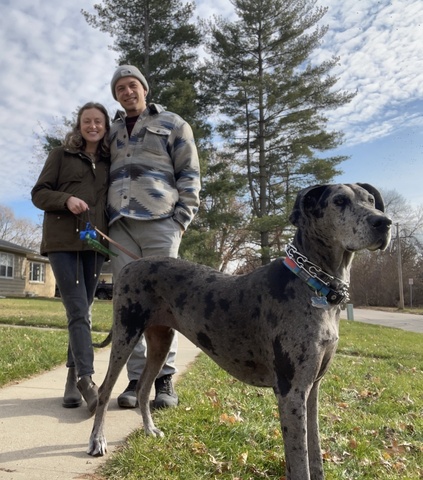
Nature has always had a special place in Haas’ life. Growing up in Solon, Iowa, it was all around her. When she hikes with her husband, Alex, and dog, Merle, or when she’s swimming in nearby Lake Macbride, it reminds her that human experience is part of the natural world, not separate from it.
“I think what draws me to nature is the fact that you can escape into it and feel part of something bigger,” she says.
She was also influenced by seeing her mother, Lauren Hanna (92MD, 95R), serve as a family medicine doctor in her hometown. Haas says her motivation to pursue medicine came from its inherent commitment to service.
“I decided to become a doctor because it’s the most ubiquitous and diverse skill set you can have,” Haas says. “You can take it anywhere and serve any community. It’s rewarding, and it’s always needed.”
Carlyn Haas will graduate with her combined Doctor of Medicine and Master of Public Health degree in May. The doctor she will become has grown from her experiences with health outreach, work in nutrition, and lifestyle factors of health, and her desire to incorporate public health principles in her primary care practice.
Following her passions
As an undergraduate at Eckerd College in St. Petersburg, Florida, Haas studied biology and Spanish. Though her roots are in a small town, Haas’ parents encouraged her to broaden her horizons through travel and language learning.
“My parents instilled in me and my siblings the importance of interacting with people different from yourself,” Haas says. “My mom is bilingual and lived in Chile for several years. Growing up, I saw how learning a second language unlocks your potential to go places, connect with communities, and build relationships.”
Haas wants to be of service in communities like the one where she grew up. A member of the Carver Rural Iowa Scholars Program, her medical school journey was full of hands-on learning outside the typical curriculum — from acting as an interpreter and clinic volunteer with the Iowa City Free Medical and Dental Clinic to running a food rescue route with local nonprofit Table to Table.
“Table to Table bridges the gap between abundance and hunger,” Haas explains. “We collect excess food and redistribute it to partner organizations addressing food insecurity. They embody simple, community-driven solutions to big systemic problems like food insecurity, food access, and the environmental impact of our food systems.”
Volunteering helped Haas stay connected to her motivations through the stressors of medical school. Her work with another nonprofit, Proteus, grew her interest in the social determinants of health. The organization provides services to farmworkers and their families, including health care.
Collaborating on nutrition-focused research
Meanwhile, she was contributing to research on how nutrition impacts health. Working with Carver College of Medicine faculty member Terry Wahls, MD, Haas studied how dietary and lifestyle interventions could affect symptoms for multiple sclerosis patients. Another impactful collaboration with a postdoctoral researcher, Solange Saxby, PhD, brought Haas in on a project surveying how women with MS managed breastfeeding and perinatal care.
“That experience reinforced how meaningful dietary and lifestyle interventions can be in managing chronic disease,” Haas says. “Seeing the disparities reminded me how much work needs to be done in communication, education, and patient-centered care.”
She shared her passion for nutrition and lifestyle-oriented care with other medical students through the Nutrition in Medicine Interest Group, for which she served as co-president.
“Food is a way that everyone interacts with health and culture every day,” Haas says. “The Nutrition in Medicine Interest Group was an opportunity to come together as students and learn more about how physicians can use their role to teach patients about their health through something as ubiquitous as the food we consume.”
Bringing it all together
Her varied interests began to overlap organically. The environment, social conditions, nutrition, activity, and other factors come together every day to create a holistic picture of an individual’s health. That realization led her to pursue the combined MD-MPH degree.
“I realized that occupational and environmental health is a whole area of public health with scientists dedicated to these questions,” Haas says. “I wanted to be part of that, and I’m grateful to Carver for making it possible.”
The additional education informed her approach as she finished medical school. She began to see the relationship between the environment and health everywhere.
“For me, the common ground is remembering and honoring the fact that the two are interrelated,” Haas says. “We need to take care of our environment in order to take care of our health, and we need to think about how our health care system impacts the environment as well.”
After residency training, Haas hopes to embark on a career that balances variety with continuity of care.
“I want to take care of a panel of patients as they grow and change. I want to teach, because understanding material well enough to communicate it is incredibly valuable. I also hope to do research,” she says.
She encourages future medical students to keep their own roots at the heart of everything they do in medical school.
“Don’t forget the things that are important. Don’t forget why you chose medicine,” Haas says. “There will be hard days and long nights throughout your whole career, but staying connected to your ‘why’ will be your North Star.”